Plan revealed to double job creation and boost Gloucestershire economy by £400m
Experts believe Gloucestershire’s Net zero target is not an unsurmountable challenge but an opportunity to transform the jobs market and deliver a £400 million boost to the county’s economy.
Dear reader,
I’m assuming most of you are flaked out due to the heat, wondering how to stay cool, bored with scrolling and open to the idea of something worthwhile to read. If so, you concentrate on staying cool and read on.
Strategy documents of any meaning from councils can sometimes seemingly take an age to produce and feel of little consequence.
What caught our attention about the one below that our main story focuses on is that businesses have bought into it, education and training providers have bought into it and councillors are fronting up in public about it - all openly enthusiastic.
Not since the days of GFirst LEP, the now-defunct local enterprise partnership, has there been so much singing from the same hymn sheet.
Who cares? One delegate told me the challenge is that “there’s no money around at the moment” and partnership working is the way forward. With prospects for young people tough, our economy flatlining, how to magic something out of the hat then?
The main story below focuses on a a plan to do just that and more - a road map to a £400m boost to the county’s economy: it outlines a strategy that could double the number of jobs in what we now call the green skills sector, and put Gloucestershire on a pedestal.
Which is why we’ve dedicated so much time to the report. Have a great weekend.
Best regards,
Editor | 07956 926061 | LinkedIn: Andrew Merrell | andrew.merrell@raikesjournal.co.uk
A festival with a difference

Gloucestershire is famous for its festivals. Fighting for a place on the busy early summer calendar and fast-approaching is a music festival on a Five Valleys hilltop serious only about having a good time. Think music festival crossed with a mad village fete; think small British festival at its very best with that odd, an edgy mix of music, good food and family vibes, dedicated to providing one thing – good times. We’re here to tell you there are tickets left.
Headlining this year’s festival are Heather Small, Tinchy Stryder, Chesney Hawkes, BBC Radio 1’s Charlie Hedges, Dick & Dom and Discolicious featuring Woody Cook, alongside local favourites Casual 6. This is Chalfest also showcases 16-year-old Ambereye, making her festival debut after growing up attending Chalfest every year since the very first festival.
Five stages will be packed with entertainment, with 15-plus street food vendors, six bars serving everything from Clavell & Hind beers, Westons Cider and Woodchester Valley wines to handcrafted cocktails from Uncommon Distillery, plus a lively Comedy Tent and the much-loved KidsZone. Due to take place on 16 and 17 of July at France Lynch Pleasure Grounds, Chalford Hill, Stroud. Tickets here.
Plan revealed to double job creation and boost Gloucestershire economy by £400m
Experts believe Gloucestershire’s Net zero target is not an unsurmountable challenge but an opportunity to transform the jobs market and deliver a £400 million boost to the county’s economy.
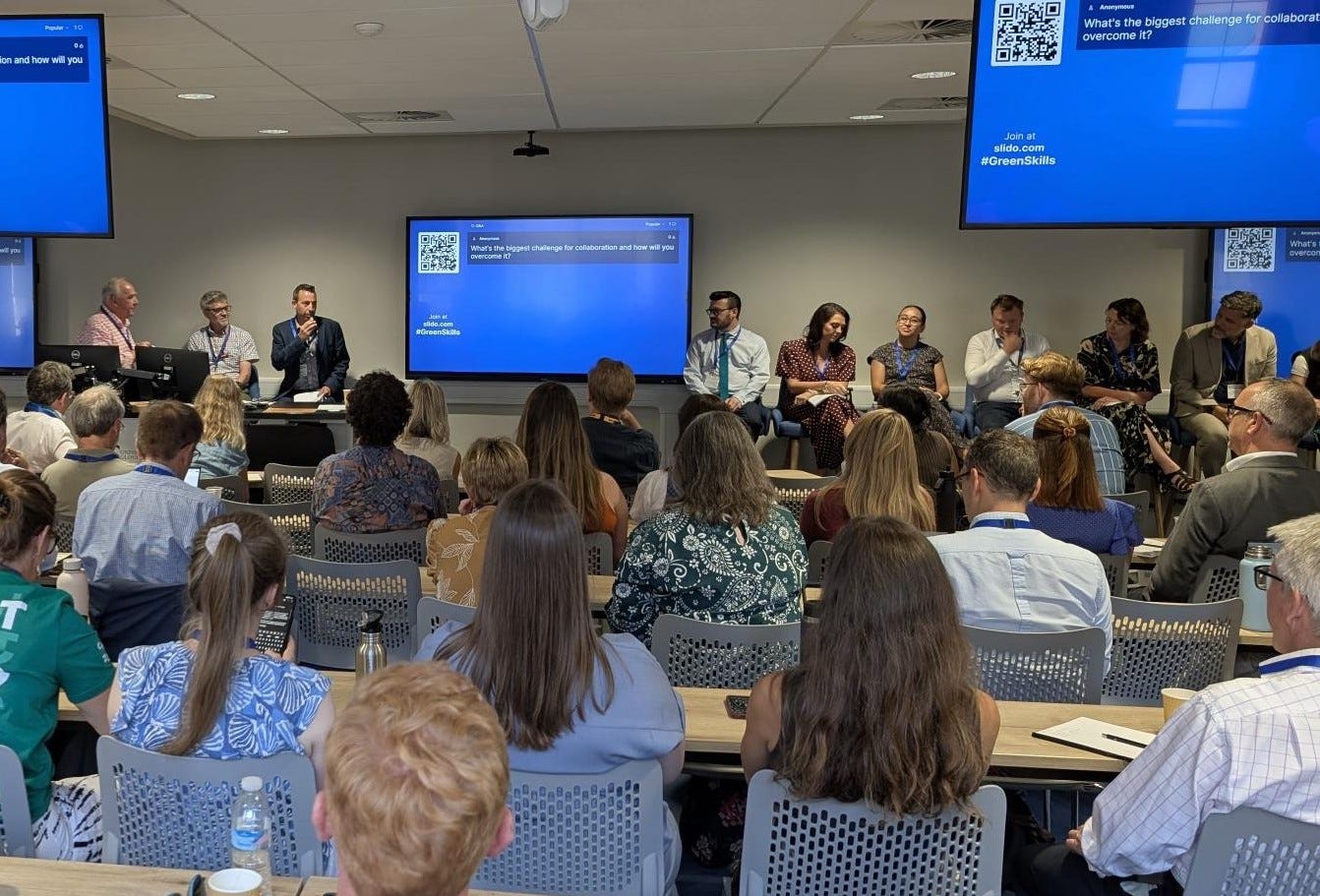
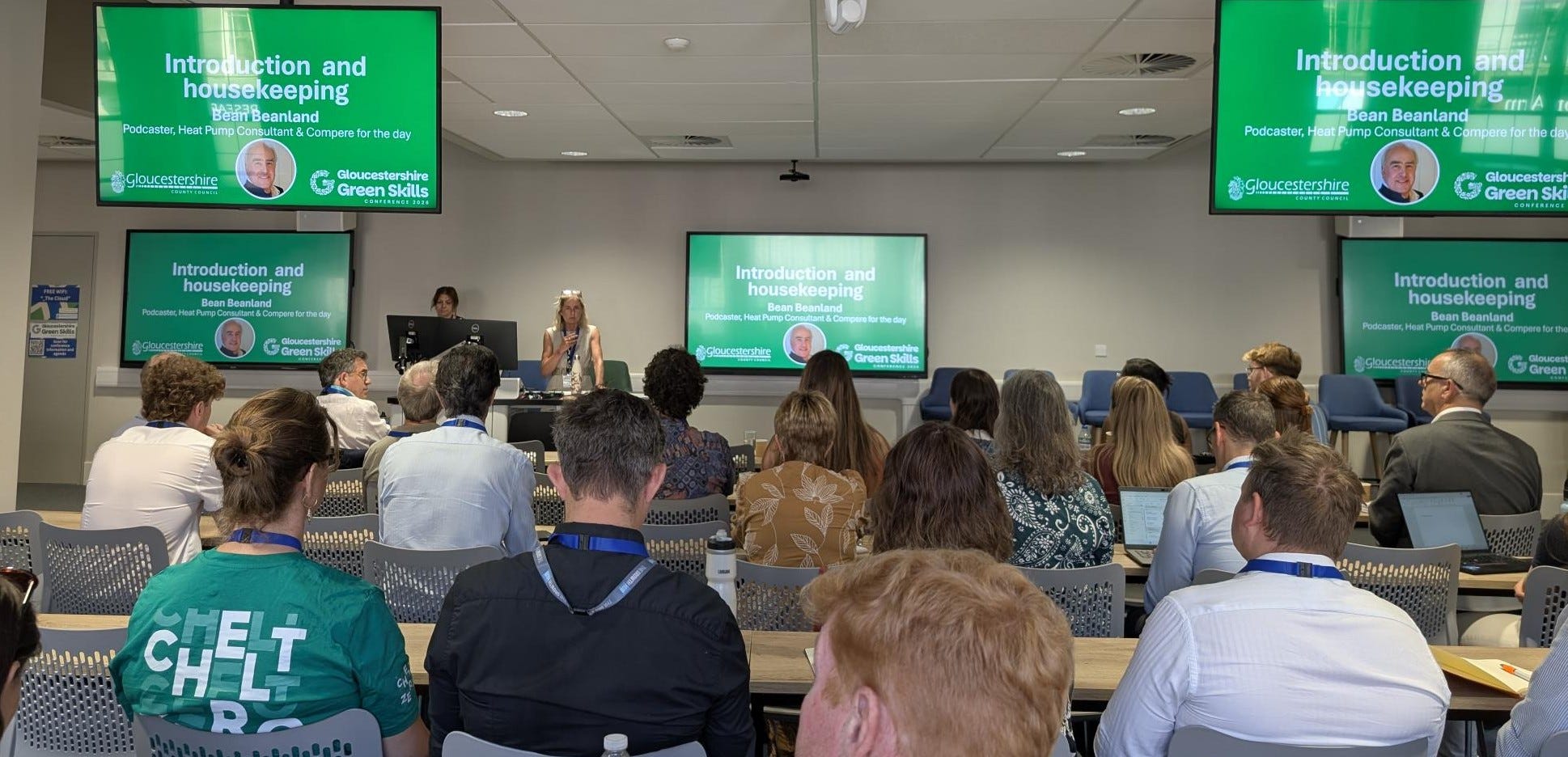
Businesspeople, academics, councillors, college and university leadership teams and assorted experts gathered at the University of Gloucestershire on Wednesday to hear how the county’s net zero commitment has the potential to transform its economic fortunes too.
This was the Gloucestershire Green Skills Conference and the roadmap that had everybody talking is the Gloucestershire Green Skills Strategy, a document outlining how the county’s legal commitment to reduce net greenhouse gas emissions to zero by 2050 can become an economic catalyst.
It’s a catalyst, we are told, that could double job opportunities in the green skills market – with particular emphasis on construction, position the county as a leader in the sector, and generate an incredible £400 million boost to its economy.
Those who wrote the report and the businesses and academics on board all believe it’s possible, and they were there to front up to explain why and what the challenges are, and the mood was upbeat.
Councillor Linda Cohen, who opened the conference and officially launched the strategy document, said: “Today we’re all taking another important step to working together and having the conversations that will help us to meet these challenges.
“We must have an entrepreneurial and collaborative approach we cannot wait for government or permissions, we have the talent, the expertise and the resources here in Gloucestershire, the starting bell has sounded, we will be the leading green skills county.”
A major part of piece of the jigsaw required to make Gloucestershire the “leading green skills county”, the buy-in not just from colleges, training providers and universities, was demonstrated by the presence of representatives from Gloucestershire College, SGS College, Cirencester College, the Royal Agricultural University and Hartpury University and Hartpury College.
Their expertise in food, farming, agritech, construction and even digital skills, all key to the strategy working. All areas which are a focus of the strategy.
Pieces of that jigsaw yet to be fashioned were also discussed, importantly the need to change our mindset about so many things – from educating all ages about the opportunities in the county, turning people on to construction and apprenticeships and the incredible careers that direction could lead to, through to better careers advice and a campaign to reach primary school age learners to spread the messages to them too.
Dr Katerina Kantartzis, an associate professor of health and wellbeing, and deputy head of the school of education, health and science at the University of Gloucestershire, said: “Achieving Net Zero will not happen through tech alone. It will happen through people.
“They (people) will retrofit our homes, transform our agriculture, meeting challenges we don’t even know about yet.
“Many of the challenges we face are global, but the solutions begin locally.”
Dr Tanya Lowes, head of clean energy, agriculture, environment and animal care, and protective services at Skills England, said the strategy document dovetailed neatly with the Government’s Clean Energy Jobs Plan.
“The plan focuses on recruiting and training the right people with the right skills,” said Dr Lowes.
“The number of jobs supported by clean energy industries could at least double in every region of England as the sector grows from around 440,000 jobs in 2023 to support 860,000 jobs across the UK by the end of the decade.”
Successful execution of the strategy could be far-reaching, said David Owen.
Owen, the county council’s director of economy and environment and part of the panel from academia and the local authority that took questions about the strategy, said: “Gloucestershire has some of the most deprived areas in the country, and in a county which is otherwise considered wealthy that should not be acceptable.”
Government figures describe Gloucestershire as an affluent county but also recognise 12 of its neighbourhoods across Cheltenham, the Forest of Dean Gloucester as ‘highly deprived’.
Kenny Lynch, professor of development and community at the University of Gloucestershire, spelled out the potential transformative power of better cooperation between within the county.
“Between us we have about 16,000 staff and 45,000 students. That’s a massive potential if we work together,” said Prof Lynch.
Andy Bates said the solution to achieve more skilled staff was not simply offering more courses or training more people.
“We have seen the number of adults taking up our courses plumet. Some of those courses might even be free. They are usually focused on some element of retraining.
“The impression we get is it is because companies cannot spare the time for their staff to do that training.
“If I advertised another apprenticeship tomorrow you can guarantee it will be over-subscribed,” he added, arguing the appetite to train among the younger generation was strong.
“What I struggle to find is a business that will take that person on afterwards or during to support them.”
The Government push to drive apprenticeships has worked when you look at the headline numbers, but beneficiaries have often been existing senior staff. Opportunities for those starting out have actually been in decline.
Gloucestershire College is already well-positioned to help drive any construction green skills training, said Bates. In September 2024 it opened a £5.5 million sustainable construction training centre at its Cheltenham Campus to address what was already predicted to be a regional shortage of skilled workers projected to reach 6,400 annually by 2025.
What it needed was businesses to be incentivised to step up.
On the panel and involved in compiling the strategy document, written by Jon Hickman, was also Natalie King, managing director and principal of AccXel, the UK’s first industry-led construction school, headquartered in the Forest of Dean.
“Businesses still also need to hear from Government what its policies are so they know what skills they need to invest in. There are a lot of parts to join up. But I am very positive and excited by the prospect of what we’ve talked about today,” said King.
Gavin Murray, deputy principal at South Gloucestershire and Stroud (SGS) College, reminded everyone that the county already had a specialist green skills and technology training centre – SGS’s facility dedicated to just that at Berkeley, south of Gloucester.
It was a unanimous and convincing account from all on the panel of institutions on the front foot, bought into the green skills strategy.
The solutions might be ‘people’, but this was where the perceived challenges lie too in the county making the transformative plan a reality.
A speech by Dr Rachel J Wilde, a social anthropologist and associate professor at UCL who researches employability and transitions into work, subjected the strategy document to some critical analysis.
Comparing its projections to the results of research done nationwide, she spelt out that success rested on the need to engage better, communicate better, collaborate more and forge better partnerships. In particular, the need to understand what young people wanted.
And in a thought-provoking and eloquent speech that had his audience rapt Professor Matt Reed, of the University of Gloucestershire, suggested as much as well.
Teasingly playing his academic credentials he introduced the room to ‘pluralistic ignorance’, the idea that individuals often privately reject a norm, sometimes passionately (for example, that climate should be out utmost priority), but publicly go along with it because they mistakenly assume everyone else supports it.
The result is a pervading perception of a community indifferent to climate change and the door to change closes.
“If we all communicated a little more honestly, and perhaps didn’t do so much twiddling with a thumbs on our phones so much, we might understand one another a little better.”
Asked by a delegate what he would do to create the desired sense of urgency and change and protect it against a populist party like Reform entering Downing Street and reversing any such momentum he said: “The antidote to populism is more democracy.”
In short, working together, talking together, sharing views and asking one another what the obstacles are that we need to overcome to see a clear path ahead.
How will such debates find the public consciousness without an independent, critical, media platform to hold everyone to account?
Raikes put the question via a digital portal to the assembled panel, but it did not have time to address it and many more questions.
But with so many different agencies, public and private bodies, businesses and educators and trainers backing the strategy document publicly this feels like it has momentum already.
Cllr Cohen said: “This is an important moment which will define the county’s economic and environmental future.
“The strategy will determine our energy and food security which is predicated on having a skilled green workforce. This is as much about farming, field and forests as it is about housing, roads and transport.
“We have committed to reduce the county’s emissions by 80 per cent by 2030 and to achieve Net Zero by 2045.
“To achieve this we’ll need to see a transformation of our built environment, energy infrastructure and transport, but this of course all relies on a skilled, locally based work force.
“There are huge rewards if we can get this right, not only to the environment but with a £400 million potential boost to the local economy.
“The green skills strategy gives us the blueprint to make sense of the complex and contested landscape and above all to bring together our unique portfolio of educational institutions to create a federated faculty including Gloucestershire, Hartpury and Royal Agricultural universities which will give us an unrivalled collaborative offering which will allow us to best deliver against industry demands for green skills.
“Government initiatives such as the Clean Energy Jobs Plan and the Warm Homes Plan support the proposed Green Skills Strategy 2026–2030, with £15bn of subsidies, incentives and low-interest loans for consumers to retrofit their homes to make them more efficient,” she said.
But the time to act was now.
“The current pace of workforce transformation falls significantly short of meeting nationally forecast demand.
“The Local Skills Improvement Plan (LSIP) identifies critical shortages in retrofit coordination, heat pump installation, and digital-green hybrid skills.
“Given the significant government targets and incentives for electrification of home heating and transport, this presents Gloucestershire with a significant opportunity to develop a significant number of new highly skilled jobs.
“We want to become a centre of excellence that will make Gloucestershire irresistible to green start-ups and established businesses and drive investment into the county.”
“The proposed strategy will promote innovative and supportive ways of engaging with the local construction sector which is dominated by small and medium enterprises (SMEs), to overcome structural barriers to training, primarily the opportunity cost of time off-site.
“At a time when the headlines are dominated by statistics about growing unemployment and, in particular youth unemployment, this is vital to give our young people and in fact older generations the opportunity to discover the rich and diverse range of jobs in the green skills sector.
“This is the opportunity to train or retrain to be able to enjoy a wonderfully fulfilling and sustainable career which benefits the community and the environment and puts Gloucestershire in pole position to become a destination county for young people and more experienced, skilled workers looking for an improved quality of life and to be in the heart of progression and innovation in the green skills sector.
“It is vital that we do this from the ground up. We need to start the conversations in primary schools about climate change, our environment, farming, house building, sustainable transport and the careers that follow.
“We need to be talking to pupils in year five and six before they move to secondary schools.
“We must continue to work towards a secondary school careers service that is integrated with every one of our schools and accessible to pupils.
“We need to be educating our teachers as much as our pupils while recognising the limits of what else they can accommodate within the curriculum and the part that employers must play in offering worthwhile work experience and school sessions.
“We must encourage girls to consider the trades – plumbing, electrics, building and engineering – we need equivalent numbers – the apprenticeship route to be as valued as a degree.
“Today we can help ensure the future security of our county. We have government funding for officer time to drive this project forward, together with agreement and endorsement across education and industry and with real ambition at the heart of the plan.
“I would end by commending the outstanding work of Jon Hickman (author of the Green Skills Strategy) who has worked so hard to deliver not merely a vision but a robust strategy which will underpin Gloucestershire’s future.”


