

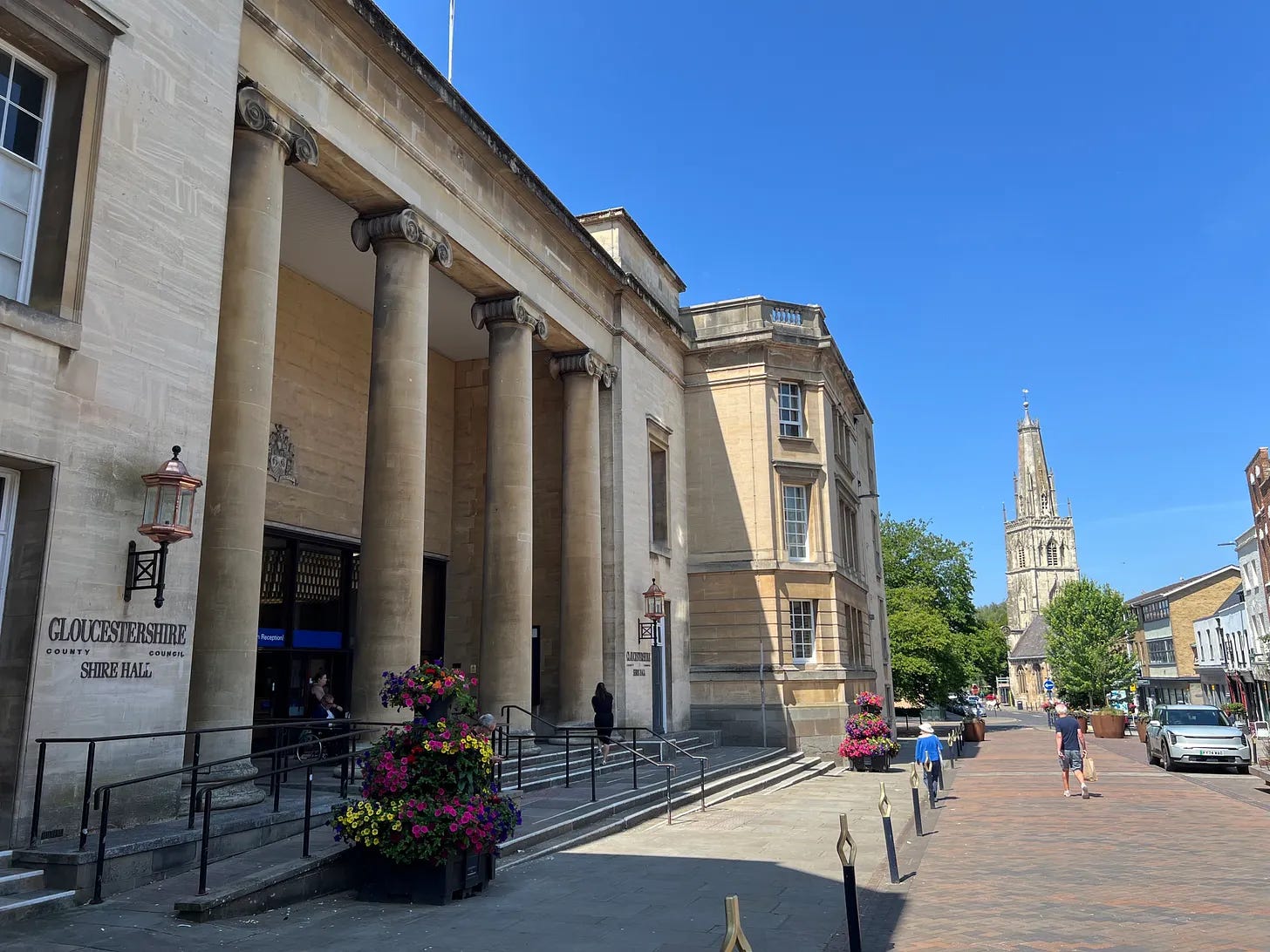
A major council shake-up has been confirmed for Gloucestershire as the government announces its decision on how the county will be run in the coming years, writes Carmelo Garcia.
Gloucestershire will move to a single unitary authority, replacing the county council and all six district and borough councils.
It is expected that elections to the new council would go ahead in May next year with the new structural changes then established in April 2028.
At that point the current county, city, and district councils will be dissolved.
The two alternative ideas for the county – to create a ‘Greater Gloucester’ or split the county into ‘East and West’ have now been ruled out.
Gloucestershire County Council’s Liberal Democrat leader Lisa Spivey said she was pleased with the decision.
“This is what the county council and three other councils supported and government have clearly listened to us when making the decision,” she said.
“Keeping Gloucestershire together means that we can focus on the things that really matter for residents – good quality services whether that’s roads, schools or health care, and growing our economy to offer opportunity for all.
“Liberal Democrats will be continuing to focus on ensuring that there is a smooth transition to the new council and that most importantly, we design services fit for the future and where residents, businesses and our communities are embedded into the decision making which affects them.
“I will be working closely with officers, councillors, and stakeholders across
Gloucestershire to make sure that we make the most of this reorganisation.
“This is not something we wished for, and the cost of delivering it is something I believe government should be funding, not Gloucestershire’s taxpayers. I will be asking government to stump up the money.
“There have been differing opinions on the models proposed amongst Liberal
Democrats, but we have a proven track record of delivering for residents and will continue to do so.”
Councillor Vernon Smith, leader of the Reform UK Group at Gloucestershire County Council, has also spoken out against the process stating nobody in the county “voted for this”.
“This reorganisation was imposed from Whitehall, and residents were never given a referendum on the future of their own local government. That is not how Reform UK would have done it.”
However, Cllr Smith added: “That said, of the options on the table, a single council for the whole of Gloucestershire is the least damaging outcome.
“It avoids carving the county in two, avoids duplicating chief executives, directors and administrative bureaucracy, and it matches what the overwhelming majority of residents who responded to the consultation actually said they wanted.
“But warm words about savings mean nothing unless they are delivered. Reorganisations of this kind have a habit of costing taxpayers a fortune in consultants, redundancy payments and rebranding before a single penny is saved.
“Reform UK will be watching every pound of transition spending like a hawk, and we will oppose any attempt to use reorganisation as cover for council tax rises or cuts to frontline services.
“The new council will start with a blank sheet of paper. In May 2027, the people of Gloucestershire will decide who writes on it.
“Reform UK will stand ready with candidates in every corner of this county, offering a council built on transparency, fiscal discipline and common sense rather than the waste and ideology residents have endured for too long.”
City council leader Jeremy Hilton said: “I am disappointed by the decision of the Labour government to create a massive single unitary council for Gloucestershire.
“At 670,000 residents, it will be the third largest unitary authority in England. A council of this scale will inevitably be too big, too distant, and too remote from the communities it is meant to serve,” the Liberal Democrat said.
“For Gloucester, the consequences are profound. For the first time in centuries our city will lose its own council, a historic institution that has shaped Gloucester’s identity, civic life, and democratic voice since the Middle Ages.
“This is sad news indeed. Our community risks losing influence over the decisions that affect us most, as Gloucester becomes just one part of a very large county wide authority.
“I fear for our civic leadership, especially the centuries old roles of the Mayor and Sheriff, which have embodied Gloucester’s heritage and given our city a proud and visible voice.
“Their future is now uncertain within a giant unitary structure that may not value or preserve these traditions.
“Local identity matters. Local voice matters. Local accountability matters. A single unitary council risks weakening all three.
“Liberal Democrats in Gloucester will continue to battle for the city in the new local government structure. Our city deserves the best.”
However, Conservative group leader at Shire Hall Stephen Davies said: “This is great news for the people of Gloucestershire.
“One Gloucestershire is the only decision that makes sense financially but also creates the opportunity to create a new Council that will be able to deliver better services without wasting money on splitting the existing services.
“There is exciting potential for joined up local government in areas of planning, waste collection and disposal, housing and many more. Looking across the country I am relieved that we have not been treated like other areas and split up.”
All three local government shake-up proposals developed in Gloucestershire were considered by ministers after each received the backing of at least one council.
“The Government wants to see district authorities merged with county councils in England as part of their drive to simplify local government and create stronger local councils.
Gloucestershire County Council has been working with the six borough, district and city authorities over the last year to develop options for the ministers to review.
“All options involved merging the districts with Shire Hall and creating one or more unitary councils providing all of their services:
CHOSEN: A single unitary authority to cover the whole area represented by Shire Hall. If taken forward, this council would be made up of 110 councillors. The current district authorities in Gloucester, Cheltenham, Cotswold, Forest of Dean, Stroud and Tewkesbury will be merged with Gloucestershire County Council.
Another option involved creating a unitary council in the East made up of Cheltenham, Cotswold and Tewkesbury and another in the West composed of Gloucester, Stroud and the Forest of Dean. Under these plans there would be 58 councillors representing the West and 52 in the East.
A separate plan for two unitary authorities was developed by Gloucester City Council. This would involve a Greater Gloucester council with a separate unitary for the rest of the county.
This would have 52 councillors for Greater Gloucester based on 18 Gloucester City wards and new wards for surrounding parishes and 81 for the rest of Gloucestershire, based on two per county council divisions.
A single council was expected to save nearly £21m per year, with £164m in net savings over the next 10 years while two unitary councils would save just under £11m a year, with more than £55m saved in 10 years.
Over the last year, each of the councils held a debate over which option they preferred.
The ‘One Gloucestershire’ option gained the support of the County Council, Cotswold District Council, Tewkesbury Borough and Stroud District Council.Cheltenham Borough Council supported the East-West proposal while City Council leaders agreed to submit their Greater Gloucester scheme to ministers.
The Forest of Dean District Council voted against all of the above options amid concerns that the process will ultimately erode local democracy.
MPs in the county were split over their preferred option. Labour’s three MPs Alex McIntyre (Gloucester), Simon Opher (Stroud) and Matt Bishop (Forest of Dean) backed the East-West split option along with Liberal Democrat Max Wilkinson (Cheltenham).
Meanwhile, fellow Lib Dems Roz Savage (South Cotswolds) and Cameron Thomas (Tewkesbury) and Conservative Geoffrey Clifton-Brown (North Cotswolds) backed the single unitary proposal.
By Carmelo Garcia, local democracy reporter for Gloucestershire. carmelo.garcia@reachplc.com
*The Raikes Journal is the only independent news outlet in Gloucestershire approved to use the copy of the BBC local government reporting service. Why? Only independent, credible journalistically-led platforms that meet the BBC’s high standards win that permission.
The right decision to have one unitary for the county. It will make for more efficiency in its operations and enable more focus on economic growth